Squat vs. leg press: the muscle gains are the same when volume matches, per a 2025 RCT of 70 women
4 studies · Kassiano et al. 2025 RCT
5 min read
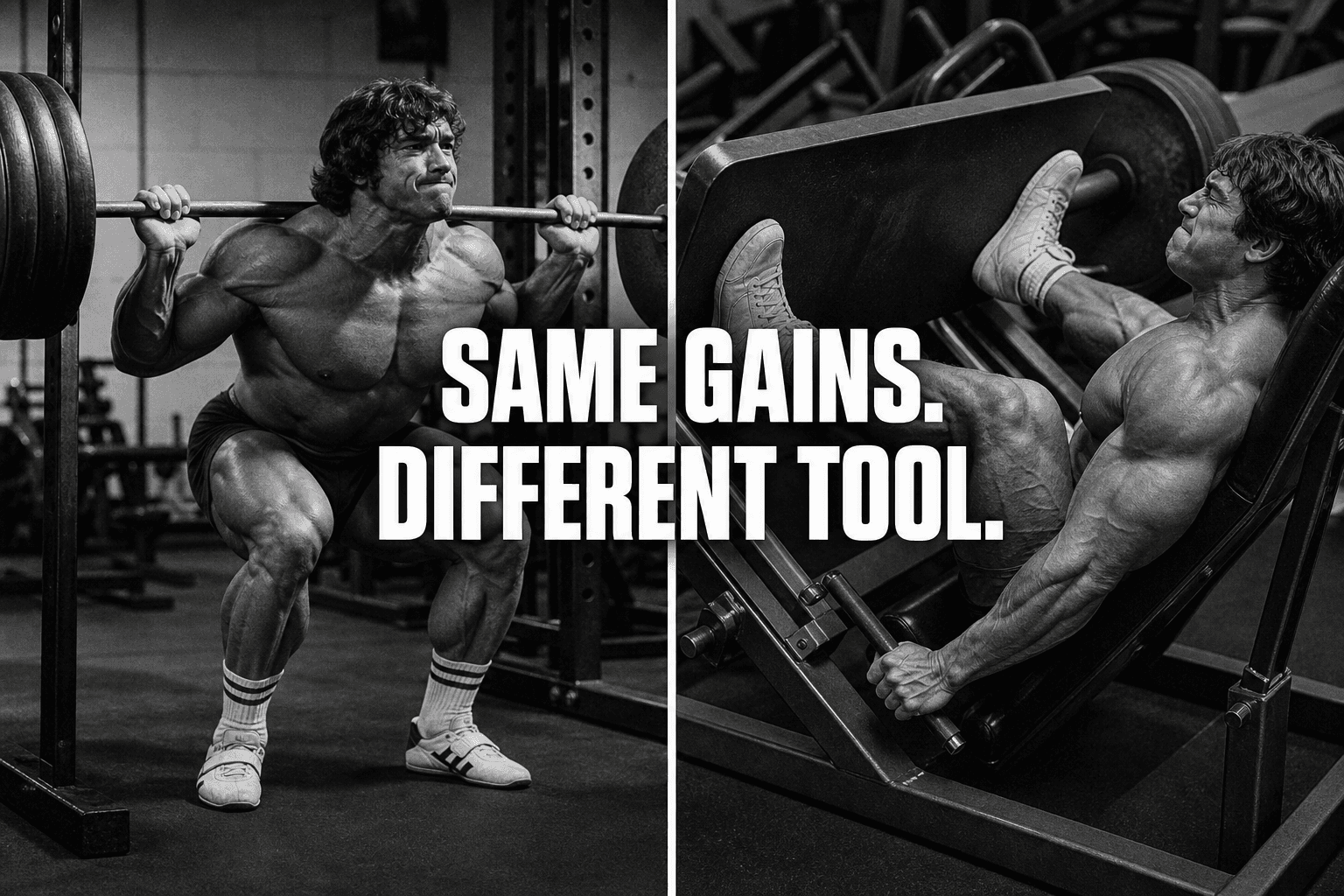
The answer: both build the same muscle
Stop treating this like a debate. When sets, reps, and effort are matched, squats and leg press produce virtually the same lower-body muscle growth.
A 2025 RCT — that's a study where 70 young women were randomly split into groups and directly compared — had one group do the leg press every session while the other rotated through leg press, hack squat, and Smith machine squat. After 10 weeks, muscle thickness of the thigh increased by +7.8–17.7% in the constant group vs. +7.5–19.3% in the rotating group. Not statistically different (Kassiano et al., 2025).
The exercise didn't determine the growth. The volume did.
The exercise didn't determine the growth. The volume did.
— Kassiano et al. (2025). Muscle Hypertrophy and Strength Adaptations to Systematically Varying Resistance Exercises. Res Q Exerc Sport.
What each exercise actually does to your legs
That said, the two movements aren't identical. Understanding the difference helps you pick the right tool at the right time.
The squat is a free-weight, compound movement — that means your whole body has to coordinate to keep the bar stable. Your core, your upper back, your hips, and your quads all share the job. It trains balance and real-world strength on top of raw muscle.
The leg press is a machine exercise. Your back is supported, the path is fixed, and the only job left is pushing weight with your legs. Less coordination, more isolation.
Neither is better. They're different tools for different situations.
Strength gains are also equal — when effort is
It's not just hypertrophy — that's the technical word for muscle growth — where the two match up. Strength gains are similar too.
In Kassiano et al. (2025), 1RM — your one-rep maximum, the heaviest single lift you can complete — on the leg press went up +24.4–32.1% in the constant group and +29.0–30.1% in the varied group. Again, no significant difference.
Rong et al. (2024) — an RCT of 24 volleyball players — measured 1RM in both back squat and leg press over 6 weeks of structured training. Both exercises improved together, confirming that training either movement builds strength that shows up across your whole lower body.
Getting stronger on the leg press makes you stronger on the squat, and vice versa. The movement pattern differs. The muscle being trained doesn't.
When to pick the squat
The squat is the better call in three situations.
1. You want athletic carryover. Sports, running, jumping — they all demand coordinated lower-body power. The free-weight squat trains your nervous system to move under load without a fixed machine guiding you. Sun et al. (2025) found that pairing back squats with jumps in an 8-week program improved countermovement jump height by +12.3% — partly because the squat itself builds the movement coordination you need.
2. You're training for total-body strength. The squat demands stability from your core and upper back. You build those as a side effect.
3. You've got the technique dialled in. Squatting badly — a caved knee, a collapsing lower back — is where the risk lives. If your form is solid, the squat's additional demands become additional rewards.
If your squat form still needs work, the goblet squat benefits is worth reading — it's the best drill for fixing squat mechanics before loading up.
When to pick the leg press
The leg press earns its place in four real-world scenarios.
1. You're coming back from injury. When your lower back, knees, or hips are in a vulnerable spot, taking spinal load off the equation matters. The leg press lets you keep training legs hard without that compressive force through your spine.
2. You want to isolate the quads. Feet low on the platform = more quad emphasis. The machine keeps everything else out of the picture, which is useful if quad development is a specific goal.
3. You're new to training. The fixed path removes one layer of complexity while you're still learning how to control your effort and load. You can focus on the basics — reps, weight, progression — without technique being the bottleneck. Rappelt et al. (2023) recorded significant strength gains on the leg press machine even in trained adults after just 4 weeks, showing the machine produces real results fast.
4. You need to push volume late in a session. When your stabilisers are fatigued and your form on the squat would slip, the leg press lets you pile on more sets safely.
The only thing that actually determines your result
Here's the part most people skip: the exercise choice matters far less than whether you're making it harder over time.
Progressive overload — adding weight, reps, or sets as your body adapts — is what forces muscle to grow. It doesn't care whether you got there by squatting or pressing.
Kassiano et al. (2025) had both groups training 3× a week for 10 weeks at 10–15 rep maximum effort. Both groups improved. The exercise differed. The principle didn't.
If you want to go deeper on this, progressive overload training breaks down exactly why overload beats any other training variable. And for managing how many sets you're actually doing per muscle group, how many sets per muscle group per week is the clearest breakdown available.
Pick the movement you can execute well, load consistently, and keep adding to. That's the whole answer.
Pick the movement you can execute well, load consistently, and keep adding to. That's the whole answer.
— Kassiano et al. (2025). Muscle Hypertrophy and Strength Adaptations to Systematically Varying Resistance Exercises. Res Q Exerc Sport.
How Planfit applies this
Planfit programmes both movements based on your training level and goal — it'll slot the squat as a primary lift or use the leg press as a volume finisher depending on what your session needs. Per-set weight and rep targets are calculated for you, and your load history is tracked across every workout so you always know when it's time to go heavier. No guessing which exercise is 'better' — just consistent, tracked progression on whichever one you're doing.
References
- Kassiano W et al. (2025). Muscle Hypertrophy and Strength Adaptations to Systematically Varying Resistance Exercises.. Res Q Exerc Sport. 10.1080/02701367.2024.2409961
- Rong M et al. (2024). Effects of Cluster vs. Traditional Sets Complex Training on Physical Performance Adaptations of Trained Male Volleyball Players.. J Sports Sci Med. 10.52082/jssm.2024.822
- Sun Y et al. (2025). The effect of complex training on strength, counter movement jump and change of direction skills in female junior table tennis players.. Sci Rep. 10.1038/s41598-025-21076-5
- Rappelt L et al. (2023). Effects of Four Weeks of Static vs. Dynamic Bodyweight Exercises with Whole-Body Electromyostimulation on Jump and Strength Performance: A Two-Armed, Randomized, Controlled Trial.. J Sports Sci Med. 10.52082/jssm.2023.226