Spot reduction is (mostly) a myth — but one 2023 RCT found a small trunk-fat edge
2 RCTs · Brobakken 2023 + Zourmand 2025
6 min read
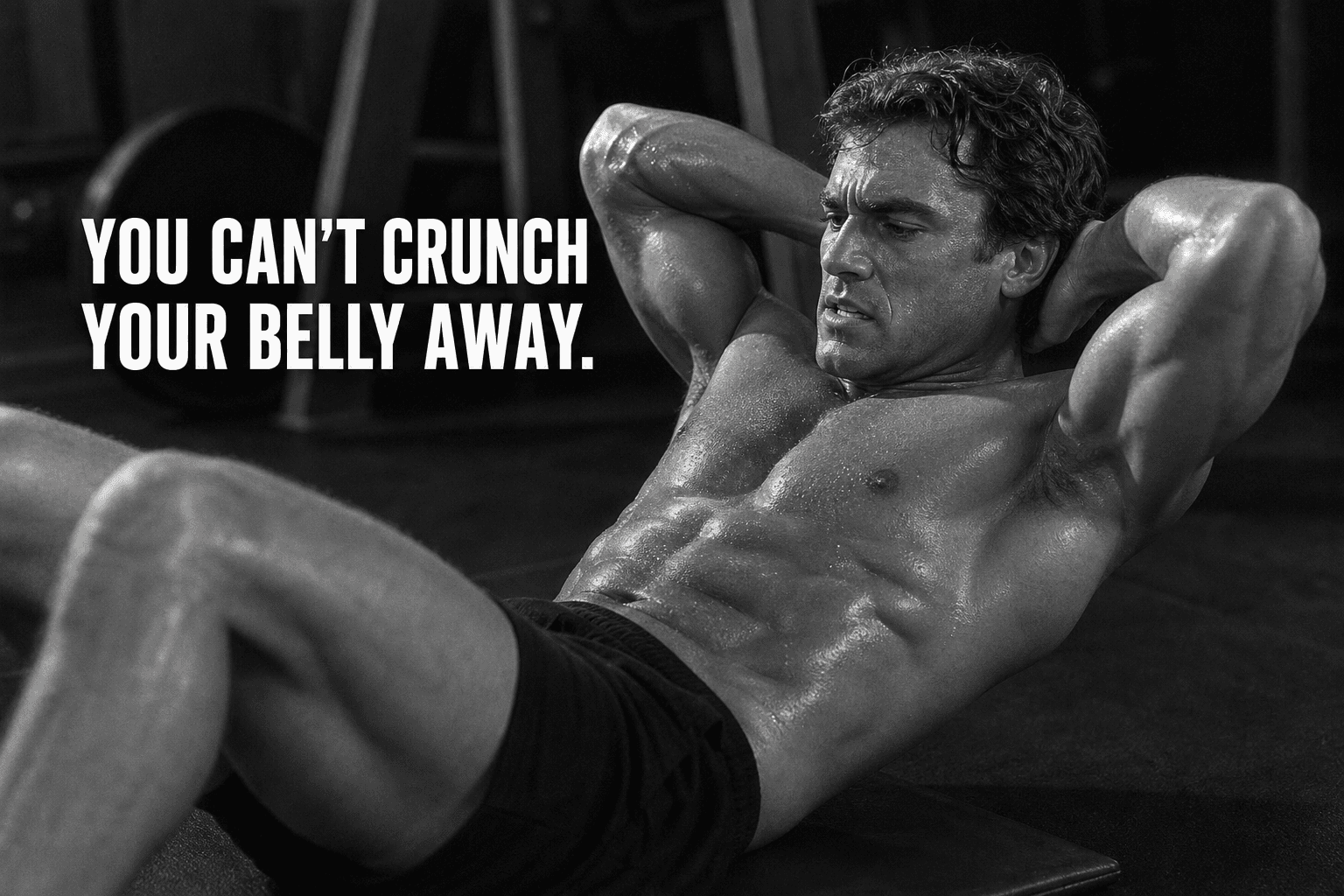
The belief: work a muscle, burn the fat above it
You've heard it a thousand times. Do enough crunches and your belly fat disappears. Do enough leg raises and your inner thighs lean out. Work the trouble spot, fix the trouble spot.
That's not how fat loss works. Fat doesn't get mobilised — broken down and released into the bloodstream — from the spot closest to the muscle that's contracting. It gets mobilised from wherever your body decides to pull it from, which is largely determined by genetics, hormones, and total energy demand.
This idea — that you can target fat loss to a specific area by exercising that area — is called spot reduction. And for decades, the exercise-science consensus has been clear: it doesn't work. Two recent RCTs add important nuance, but they don't overturn that verdict.
Why fat doesn't work that way
When you exercise, your muscles need fuel. Some of that fuel comes from fat — but the fat has to be broken down first, enter your bloodstream as free fatty acids (FFAs), travel to the working muscle, and get burned there.
Here's the problem for spot reduction: the fat that gets mobilised doesn't have to come from anywhere near the working muscle. Your body draws on fat stores systemically — from all over — based on which fat cells respond best to the hormonal signal (mainly adrenaline) that exercise sends out.
You don't get to choose the source. Your body does.
This is why a thousand sit-ups a session won't preferentially shrink your belly. The crunches might be burning calories. They're just not burning belly calories specifically.
You don't get to choose where the fat comes from. Your body does.
What the research actually says — the RCT that surprised everyone
Here's where it gets interesting. A 2023 randomised controlled trial — people randomly split into groups and compared — put 16 overweight men through 10 weeks of training. One group ran on a treadmill (45 min, 70% max heart rate). The other group did the same treadmill running plus 4 sets of torso rotations and abdominal crunches, matched for total energy expenditure so both groups burned the same number of calories overall.
Result: trunk fat dropped 697 g more in the abdominal-exercise group — a 7% reduction vs no significant change in the treadmill-only group (Brobakken et al., 2023).
That sounds like spot reduction works. But read the fine print before you rewrite your programme.
Total body fat loss was almost identical between groups: 1,705 g vs 1,134 g, both statistically significant, both in the same ballpark. The extra trunk-fat loss in the ab group was a modest edge on top of similar overall fat loss — not a dramatic targeted melt.
And the sample was small: 16 men. That's not enough to call it a settled finding.
Trunk fat dropped 697 g more in the abdominal-exercise group — but total fat loss was nearly identical. (Brobakken et al., 2023)
— Brobakken MF et al. (2023). Abdominal aerobic endurance exercise reveals spot reduction exists. Physiol Rep.
Regional exercise vs general exercise: a 2025 RCT in 60 women
A 2025 RCT split 60 obese women into three groups for 12 weeks of training three times per week (Zourmand et al., 2025):
- General aerobic training — treadmill and cycling.
- Regional aerobic training — targeted abdominal and lower-body rhythmic exercises.
- Combined training — 15 minutes general + 15 minutes regional.
All three groups lost weight and reduced their waist-to-hip ratio — a measure of abdominal fat relative to hip size. The combined group came out on top: -6.4% body weight, -13.1% waist-to-hip ratio, and the biggest drops in plasma FFAs and insulin.
But the general aerobic group beat the regional group on overall fat loss. The group doing targeted, regional exercise lost less total fat than the group just doing general cardio.
Again: working the trouble spot doesn't preferentially shrink it. Getting your whole body working does.
General cardio beat targeted regional exercise for total fat loss — even when the regional group was training the exact trouble spots. (Zourmand et al., 2025)
— Zourmand et al. (2025). Impact of regional and general aerobic exercise on molecular regulators of lipolysis. Cell Mol Biol.
So is spot reduction real or not?
Here's the honest answer: there may be a small, real effect — but it's not the mechanism you're imagining, and it won't substitute for general fat loss.
The Brobakken 2023 RCT suggests that working a region while also doing general cardio might produce a slightly larger fat reduction in that region than cardio alone. The mechanism researchers point to is local adipose tissue — the fat cells directly underneath and around the working muscle — becoming more responsive to the hormonal signals that trigger fat breakdown, possibly because of increased blood flow to the area and direct mechanical stimulation.
But here's what that doesn't mean:
- It doesn't mean crunches alone will reduce belly fat. Both groups in the Brobakken study were also running 27–45 minutes per session. The ab exercises were on top of general cardio, not instead of it.
- It doesn't mean the effect is large. A 697 g extra reduction over 10 weeks is real but modest — and came from a study of 16 people.
- It doesn't apply to resistance training the way people assume. Neither study tested weight training as the local exercise. The regional exercise in both studies was aerobic — rhythmic, sustained, lower-load movement, not heavy sets of weighted crunches.
What this means for how you train
If your goal is to lose fat from a specific area, here's what the research actually supports:
1. Prioritise total fat loss. General aerobic training — cardio that gets your whole body working — drives more systemic fat loss than targeted exercise alone (Zourmand et al., 2025). There's no shortcut around this.
2. Build the muscle underneath. You can't spot-reduce fat, but you can spot-build muscle. Adding muscle to a region increases its density and changes its shape, which is often what people actually want when they say they want to 'tone' an area. For that, progressive resistance training is what works — see progressive overload training for how to apply it.
3. If you want to add targeted aerobic work, combine it — don't substitute. The combined group in the Zourmand 2025 RCT outperformed both the general-only and regional-only groups. Adding 15 minutes of targeted movement to your general cardio may provide a small additional stimulus to local fat stores. But it only works alongside general training, not instead of it.
4. Track total volume, not targeted volume. The number of sets you put in across your whole session predicts fat loss and muscle growth far better than which body part you aimed them at. See how many sets per workout for what the data says on that.
How Planfit applies this
Spot reduction won't get you there — total training load will. Planfit programmes your full session: it picks exercises across all muscle groups, recommends working weight and rep ranges, and tracks your volume so every session builds on the last. When fat loss is the goal, consistent progressive overload plus general training volume is what moves the needle — not isolating one body part and hoping the fat above it disappears. Planfit keeps the whole picture in view so you're not wasting sessions on work that doesn't pay off.
How Planfit applies this
Spot reduction won't get you there — total training load will. Planfit programmes your full session: it picks exercises across all muscle groups, recommends working weight and rep ranges, and tracks your volume so every session builds on the last. When fat loss is the goal, consistent progressive overload plus general training volume is what moves the needle — not isolating one body part and hoping the fat above it disappears. Planfit keeps the whole picture in view so you're not wasting sessions on work that doesn't pay off.
References
- Brobakken MF et al. (2023). Abdominal aerobic endurance exercise reveals spot reduction exists: A randomized controlled trial.. Physiol Rep. 10.14814/phy2.15853
- Zourmand et al. (2025). Impact of regional and general aerobic exercise on molecular regulators of lipolysis and adipose tissue composition in obese women.. Cell Mol Biol (Noisy-le-grand). 10.14715/cmb/2025.71.10.15