Is body recomposition real? You can lose fat and build muscle at once — here's what drives it
4 studies · Med Sci Sports Exerc 2022
5 min read
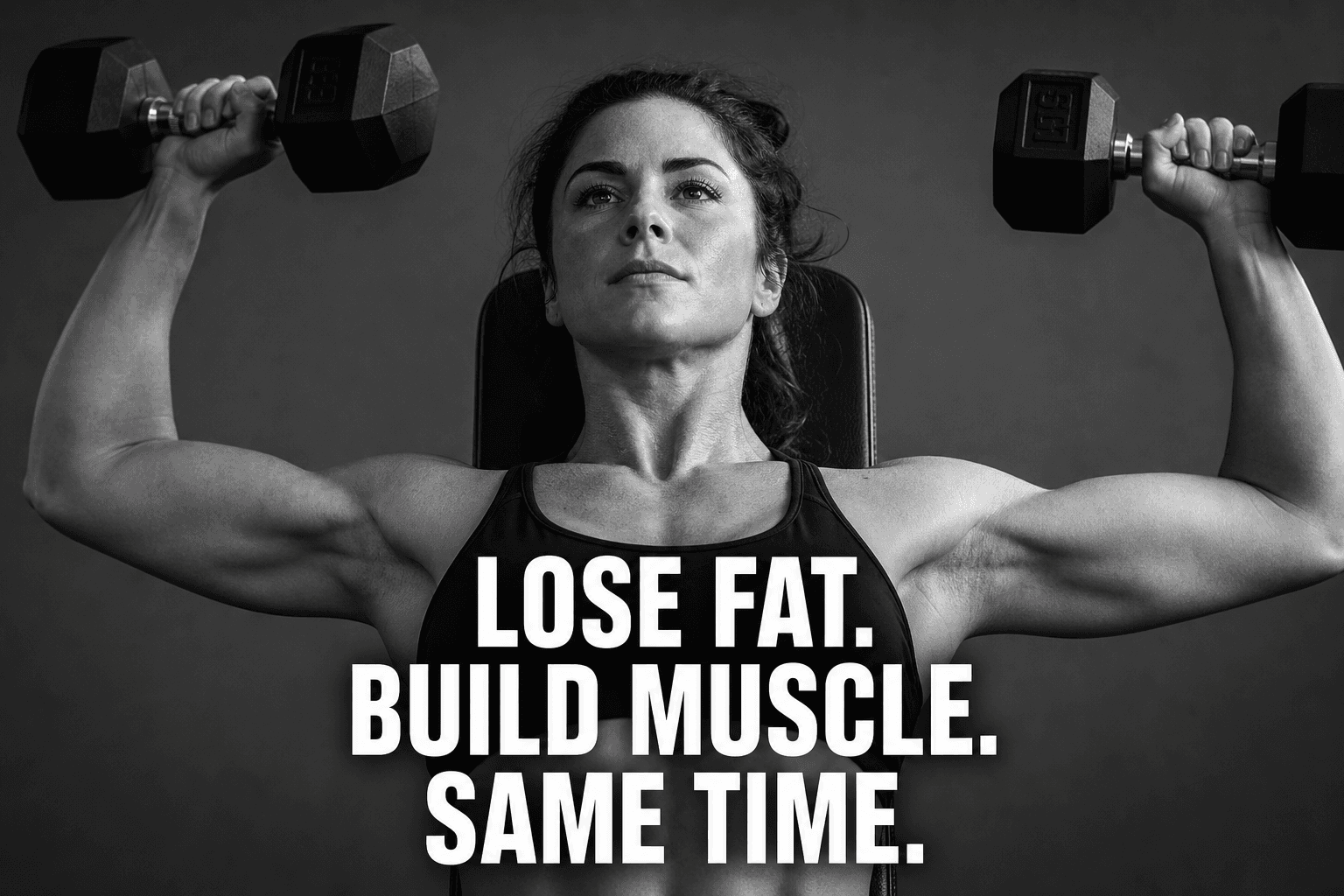
Yes, you can lose fat and build muscle at the same time
You've probably heard it's impossible. Pick one, the old logic goes — cut first, bulk later.
That's wrong. Body recomposition — losing fat mass and gaining lean muscle simultaneously — is well documented in the research, and it happens more reliably than most trainers admit.
A 2022 analysis of 130 untrained older women, published in Medicine & Science in Sports & Exercise, found that 24 weeks of resistance training increased skeletal muscle mass in every single participant while also reducing fat mass. All three protein-intake groups lost fat. All three built muscle. At the same time (Ribeiro et al., 2022).
And it's not a women-only effect — the same pattern shows up below in men, in trained athletes, and in mixed-sex trials. So the question isn't whether recomposition is possible. The question is: what actually drives it?
Every group built muscle and lost fat simultaneously — the only variable that changed the outcome was how much protein they ate.
— Ribeiro et al. (2022). Moderate and Higher Protein Intakes Promote Superior Body Recomposition in Older Women Performing Resistance Training. Med Sci Sports Exerc.
The two non-negotiables: resistance training and enough protein
Every study in this package that achieved recomposition had two things in common: structured resistance training and a protein intake above the minimum.
In the Ribeiro et al. (2022) data, women eating moderate protein (MP) gained 5.4% more skeletal muscle mass than baseline. Higher protein (HP) gained 5.1%. Low protein (LP) gained just 2.3%. The fat loss difference was smaller across groups, but the composite recomposition score — fat lost plus muscle gained, combined — was significantly better for MP and HP.
Translation: getting your protein up from low to moderate made almost as much difference as pushing it even higher.
A 2026 randomized trial by Vargas-Molina et al. tested two high-protein approaches against a control group doing the same training with no dietary guidance. Both supervised groups lost fat and gained lean mass. The control group, training equally hard but eating without structure, moved much less (Vargas-Molina et al., 2026).
Training is the trigger. Protein is the raw material. You need both.
A caloric deficit speeds fat loss — but you can recomp without one
Here's where it gets interesting. You don't have to eat at a deficit to recompose. But a mild deficit does shift the balance toward faster fat loss.
In the Vargas-Molina et al. (2026) trial, the energy-deficit group lost 2.94 kg of fat mass over 10 weeks. The isocaloric group — same protein, same training, just enough calories to maintain weight — lost 1.41 kg. Both groups lost fat. Both groups preserved or gained lean mass.
A deficit accelerated fat loss by roughly 2×, but it didn't block muscle growth.
This is the practical takeaway: if your goal is faster fat loss, a moderate deficit on top of your training works. If you hate dieting or you're training hard and need the fuel, eating at maintenance with high protein still moves the needle. Neither approach is wrong. They just produce different rates.
Deficit group: −2.94 kg fat. Isocaloric group: −1.41 kg fat. Both groups trained identically and both lost fat.
— Vargas-Molina et al. (2026). Comparison of two nutritional protocols in body re-composition of resistance-trained participants. Eur J Appl Physiol.
Recomposition isn't just for beginners
One common objection: "Sure, untrained people recomp easily, but once you're trained it stops working."
The soccer data push back on that. Honorato et al. (2023) tracked ten professional soccer players through a six-week pre-season. These are elite, already-trained athletes — not beginners. After six weeks of structured concurrent training (strength and conditioning together), they reduced fat mass by 4.1% and increased fat-free mass by 1.7%. Simultaneously.
Kobal et al. (2021) saw the same pattern with elite women soccer players over an eight-week pre-season: body fat dropped 15% and fat-free mass rose 5% — while aerobic capacity improved 28.5% at the same time.
Trained athletes can still recompose. The window narrows, yes. The rate slows. But it doesn't close. What these athletes had was consistent, progressive training stimulus plus the nutritional support to back it up. That combination works at any experience level.
The protein target that actually moves the needle
The Ribeiro et al. (2022) data show a clear threshold effect: going from low to moderate protein made the biggest difference. Going from moderate to high was negligible for most outcomes.
Practical target: 1.4–1.8 g of protein per kilogram of bodyweight per day. That's the range where muscle gain accelerates and the composite recomposition score improves significantly.
For a 75 kg person, that's 105–135 g of protein daily. Spread it across 3–4 meals. Research on protein distribution — anabolic window — suggests meal timing matters far less than total daily intake, so don't stress the clock. Hit the number first.
If you're in a deficit, keeping protein high also protects the lean mass you already have. The Vargas-Molina et al. (2026) deficit group maintained their protein at the same level as the isocaloric group — that's almost certainly why they kept building lean mass while losing fat.
What your training actually needs to look like
All the studies here used structured resistance training, 3–4 sessions per week, targeting the whole body. That's not a coincidence — it's the minimum effective dose for recomposition to happen.
The soccer studies added aerobic work on top. Kobal et al. (2021) ran 4–6 soccer sessions per week alongside 4–5 strength sessions. That's high volume — and it still produced recomposition. The key was that the strength work was equalized, not an afterthought.
If your goal is recomposition specifically:
- 3–4 resistance training sessions per week — full body or upper/lower split both work (full body vs split)
- Progressive overload in place — you need to keep adding stimulus for the muscle-building side to hold up (progressive overload training)
- Enough sets per muscle group — the research points to 10+ sets per muscle per week as the threshold for meaningful hypertrophy (how many sets per muscle group per week)
- Cardio is optional, not required — but it doesn't block recomposition when the protein and training are right
The fat-loss side happens mostly through diet. The muscle-building side happens mostly through training. Keep both dials turned up.
How Planfit applies this
Recomposition lives or dies on two things staying consistent: your training stimulus and your progression. Planfit programmes your sessions by training level, recommends the working weight and rep range for each exercise, and tracks your load across sessions so you're always getting a harder stimulus — not coasting on the same weight for months. The per-body-part volume tracker shows you whether each muscle is hitting the dose the research recommends. Log the reps, let the app nudge the weight, hit your protein target — that's the recomposition formula.
References
- Ribeiro AS et al. (2022). Moderate and Higher Protein Intakes Promote Superior Body Recomposition in Older Women Performing Resistance Training.. Medicine & Science in Sports & Exercise. 10.1249/MSS.0000000000002855
- Vargas-Molina S et al. (2026). Comparison of two nutritional protocols in body re-composition of resistance-trained participants.. European Journal of Applied Physiology. 10.1007/s00421-026-06209-6
- Honorato RC et al. (2023). Regional phase angle, not whole-body, is augmented in response to pre-season in professional soccer players.. Research in Sports Medicine. 10.1080/15438627.2022.2052069
- Kobal R et al. (2021). Pre-season in soccer: a paradox between a high volume of technical/tactical training and improvement in the neuromuscular performance of elite women soccer players.. Journal of Sports Medicine and Physical Fitness. 10.23736/S0022-4707.21.12427-2